When Do Facts Matter?
It is easier than ever to manufacture controversy. With AI and online anonimity, a person can be anyone and say anything with near impunity. Our elected officials and the government they run are not prepared for an endless cycle of propaganda, outrage, and political fear devoid of fact or nuance.
Why would someone take the time to create and submit fake comments anonymously or under a fake name? Because Ohio cares a lot about “public interest” when determining whether a (renewable energy) case can go forward. Opposition groups use every lever they have to convince neighbors and local elected officials to oppose a project with the goal of providing a clear signal to the OPSB Staff that opposition to a project is “one-sided, consistent, and overwhelming”. Their words.
Public comments serve a key purpose for opposition groups: to define a narrative for members of the community and local officials. That narrative evolves but usually goes “Look at the public comments! Opposition is overwhelming in X township!”
That message, especially when driven by false comments, is propaganda designed to pull someone one direction or another. Taken at face value with no critical analysis, these comments serve to build the state’s narrative about a given project - both what a community is concerned about and how many people are concerned versus supportive. If “public interest” is so critical to Staff’s recommendation, shouldn’t we make sure that it’s analyzed and understood?
Doing The Work
In an article from Canary Media, the author carefully lays out the evidence of widespread comment fraud by opposition to the Crossroads Solar Grazing Project. At least 50% of comments submitted in opposition to the project were anonymous or from individuals who have no record of living, voting, or existing in the county they claim to live in. OPSB Staff has made a conscious decision to ignore incontrovertible evidence of fraud:
“Beyond dozens of anonymous comments against the project, Herling found at least 34 instances in which people apparently gave false names or lied about their residence in Morrow County.
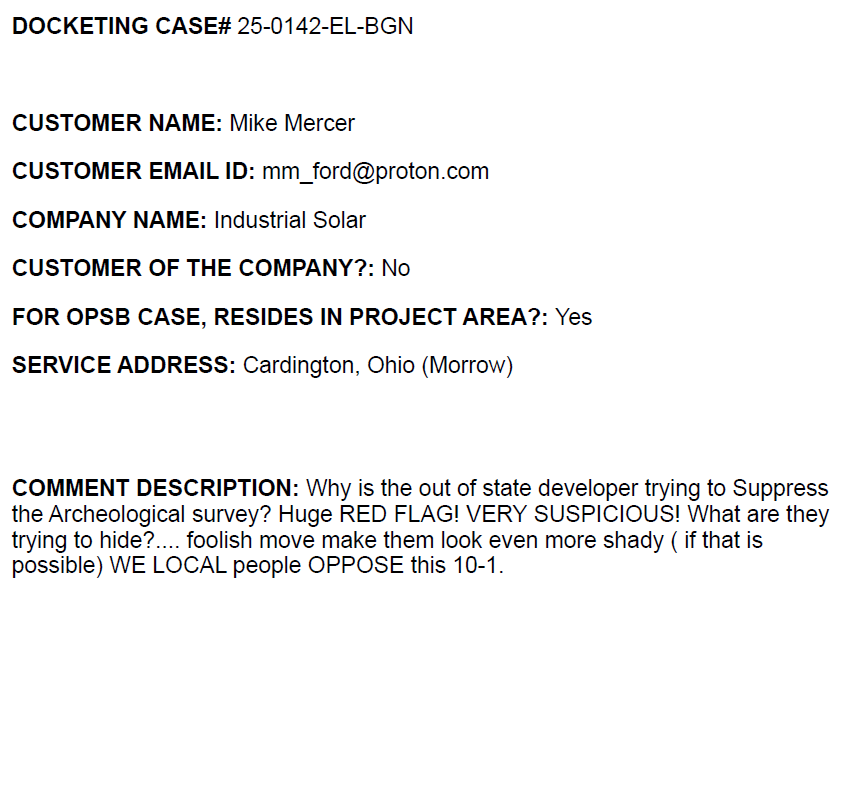
Each of these comments was negative, including the one purportedly from Roger Willard of Cardington, Ohio, which called “industrial solar … a crime against local property owners and the rural way of life we value.” Another, from Mike Mercer, who also claimed to live in Cardington, said, “REAL PEOPLE THAT LIVE HERE DO NOT WANT THE SOLAR SCAM!”
Canary Media checked all 34 instances at VoterRecords.com and Whitepages.com and was able to verify the existence of only a single name at its stated town. A message sent to the email address provided for the one exception — someone named Smith — bounced back as undeliverable. As of Jan. 31, Canary Media also found seven more potentially fake comments that had been entered into the board’s online docket since Jan. 13, when Herling began testifying.”
An analysis of anonymous and fake comments shows over 80 on the Crossroads case docket. Below is a spreadsheet detailing each one.
The Fake Comments
Don’t believe it? You can check each comment for yourself and find the originals on the OPSB Website.
Who Done It?
The widespread public interest fraud was likely coordinated by a few individuals in the community. Shockingly, the most conclusive evidence for engaging in the submittal of fraudulent comments indicates that an intervenor in the case or their immediate family submitted several of the fake comments.
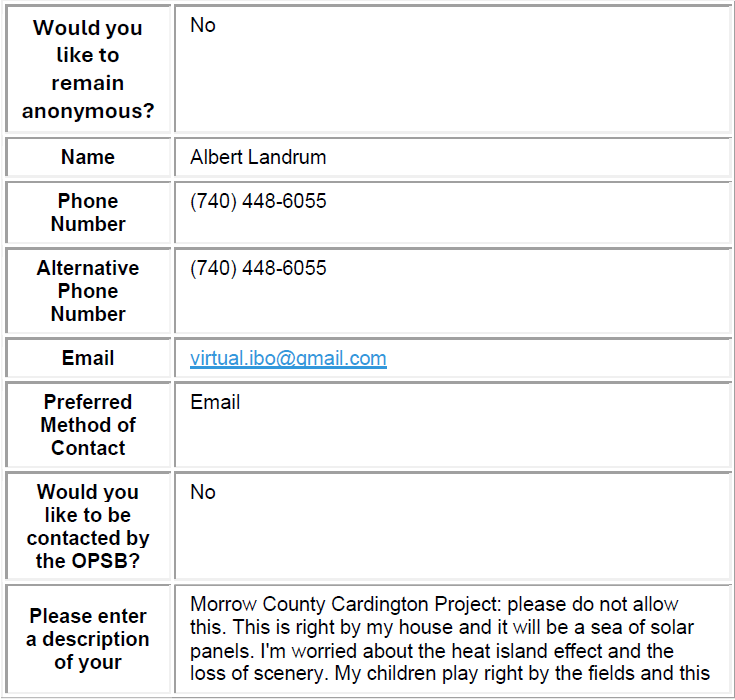
The very first questionable comment, from Albert Landrum, included an email address and a phone number. While there is no “Albert Landrum” that lives anywhere near the proposed project, the included phone number is associated family members of an individual who was a named intervenor in the case and who testified under oath.“Ibo”, which is part of this email address also appears in the email address of another comment by a member of that family. The style of that comment matches many other similary timed fake and anonymous comments in style and substance to many anonymous and fake comments.
Is it possible this is a coincidence? Of course. Anything is possible. But it’s also possible (and much more likely) that group of individuals opposed to the project felt that the ends justified the means and submitted multiple comments under various, unassuming names in an attempt to sway the opinion of local elected officials and regulators. And that they accidently used their phone number and a suspect email address in their first attempt was just a mistake.